Friday, March 4, 2011

Doing It - Matthew 7:15-28

Read Matthew 7:15-28.

    Every preacher has stories of sermons gone wrong or heard wrong.  I have my share.  “Ooh, didn’t mean it to come out that way” or “I’m pretty sure I didn’t say that” or the occasional sermon that just bombs.  But as far as I know, I’ve only had someone walk out on me once, and that was when I was preaching from today’s text. 
    It’s a hard passage.  Jesus says three really hard things.  1) Some people will be thrown into the fire.  2) Some people who think they deserve heaven will get locked out, and 3) Some people will find their whole lives come crashing down around them.
    Three years ago, on Easter Sunday, I was going to preach from this text, and I introduced myself to a new person during the greeting time.  I reached out my hand to her and she held up the sermon copy and said, “Haven’t you ever read the verse: ‘Judge not lest ye be judged’?!” 
    I said, “Umm ... yes ... actually I preached on that text last week.”
    She had angry tears in her eyes, and she said, “Well that is certainly not reflected in this sermon!” 
    I don’t remember the rest of the conversation, but I do remember that I got out my pen and made some quick edits to the sermon during the song time.  I also remember that this lady was gone before it was time for me to speak.
    Obviously, I’ve thought a lot about this experience this week.  Why didn’t I ask Matt to preach this one?  So in honor of Ms. Walker-outer, I want to make sure we all see the connections between the beginning of chapter 7 “Do not judge others and you will not be judged” and the end of chapter 7 with burning branches, closing doors, and collapsing houses.
   
    However, before we can make that connection, we need to make sure we really understand what Jesus is saying here in the end of his most important sermon.  And what he has to say is a little shocking.  If go down to the basics of all three little stories, they all follow the same basic plot.
    First, people are doing good things and have good expectations.  People are worshiping or prophesying or building a house or even casting out demons and working miracles.  In general, we would say these people are successful.  They are highly religious.  They look good, and they seem to be doing really good things.  These are the people we expect to get God’s approval and blessing.
    But in all three stories, Jesus pounds home one point again and again.  The inside matters more than the outside.  Actions matter more than words.  And simple day to day love matters more than flashy public actions.  Again and again, Jesus says these upstanding religious people will be rejected and destroyed because they did not “do” Jesus’ teaching. 
    In fact, that word “do” is probably the key word for our passage.  Jesus uses the Greek word “do” 11 times in Matthew 7.1  If we translate the Greek very literally, it sounds like this:
Whatever you want others to do to you, then you do that to them  (7:12).
Every good tree does good fruit, and a bad tree does bad fruit (7:17).
A good tree can’t do bad fruit, and a bad tree do good fruit (7:18).
Every tree not doing good fruit is cut off and thrown into the fire (7:19).
Only the one who does the will of my Father ...  will enter the kingdom of heaven (7:21).
Many will say ... Didn’t we ... do many miracles in your name (7:22).
Everyone who hears my teaching and is doing it is like the wise man (7:24).
Everyone who hears my teaching and is not doing it is like the foolish man (7:26). 
    As Jesus concludes the longest and most important sermon we have in the Bible, he has one concern on his mind: “Do it.  Actually do it.  Live this out.  Don’t just listen and walk away.  Don’t just listen and be amazed at me.  Do it.  Doing it is what matters in the end.”
    Jesus gives three specific warnings.  First, he says, “Look out for people who talk good but don’t act good.”  Some people are happy to speak for God but live for God.  It’s the living that really matters, not the talking.  It’s the life not the words.
    Second, he says, “You can say everything right.  You can be completely orthodox.  You can get an A+ in systematic theology.  You can even accomplish amazing results for Jesus and still miss the boat.”  Jesus is talking about very religious, very “Christian” people.  People do lots of stuff in Jesus’ name - sometimes amazing things, sometimes very religious things - but that doesn’t mean that they are actually in Jesus or that Jesus is in them. 
    Third, Jesus tells this story about the two guys who built houses.  Everything looked the same on the outside.  These are two decent guys who are trying to provide a home for their families.  When their houses are finished, they might look exactly the same.  Both seem to be good, strong, well-built houses.  But one of them falls apart because it has a bad foundation. 
    Jesus says that all of life depends on building our lives on Jesus.  Life depends on Jesus, but not in a sappy, pie-in-the-sky, let’s-sing-a-worship-song way.  Life depends on actually DOING what Jesus teaches.  Believing without doing is not believing.  Praising without doing is not praising.  Thanking without doing is not thanking.  Repenting without doing is not repenting.  Trusting without doing is not trusting. 
    Jesus is saying, “If you really think I’m Lord ... If you really believe I am the Messiah, the Christ ... If you really think I’m a great teacher ... If you really think I have authority ... then DO IT.  Do what I’m teaching.  Live like I’m telling you to live.”
    Life depends on Jesus’ life becoming real in our lives.  This is trust.  This is the solid rock that is not shaken in the storm.  We follow Jesus.  We trust Jesus enough to live like Jesus.  That is building our house on the rock.  That and nothing else. 

    Let’s pause for a minute and think about some ways that we often get this wrong.  In my sermon study, these days, I’ve been going back into the traditions that formed the Church of the Nazarene. 
    Phineas Bresee was the first pastor of a Nazarene Church.  He said we Christians often get confused about being a Christian really is. 
We might think giving or serving the poor makes us a real Christian.  But we may give away everything we have and accomplish nothing.
We might think avoiding obvious outward sins makes us a real Christian.  But we may avoid every sin we know and still be dark hypocrites inside.
We might think holy, religious actions like prayers and songs of joyful thanksgiving make us a real Christian.  But it could be “the form without the life ... doing it for show.”
We might think separating ourselves from “sinners” and anything that “hints of sin” makes us a real Christian.  But Bresee reminds us that Jesus “was so kind and tender and loving with sinners that ... he was [called] a friend of ... sinners.”2
    John Wesley, the founder of Methodism added another important warning: “‘What is the foundation of my hope? ... [Is it] my orthodoxy, or right opinions, which, by a gross abuse of words, I have called faith? ...  Alas! what madness is this! Surely this is building on the sand, or, rather, on the froth of the sea!’”3  We can have all the right beliefs and have none of Jesus in our lives. 

    Now think back to the beginning of this sermon.  I promised to explain how this passage fits with the “Do not judge” passage.   I think the connecting point is around two words: outside and inside. 
    A tree might look good on the outside - lots of branches and beautiful green leaves.  But only a tree that is good inside produces good fruit.  I can’t help thinking about John 15:5, “I am the vine; you are the branches.  Those who remain in me, and I in them, will produce much fruit.  For apart from me you can do nothing.”  The point is to stay so rooted in Jesus that his life flows through our life and becomes real in us.  The point is to live out Jesus’ life in our daily life. 
    Not everyone who calls out “Lord, Lord” and does many good things will enter the Kingdom of Heaven.  Beware of the forms of religion without the power.  Beware of success without faithfulness.  Beware of the spectacular, big deeds without the little unnoticed acts of service and love.  Beware of having all the outside stuff without the inside stuff.  As Paul said, “The Kingdom of God is not just a lot of talk; it is living by God’s power” (1 Corinthians 4:20). 
    A good looking house is not necessarily good.  A good looking life is not necessarily good.  For real goodness, we’ve got to look inside and dig deep.  We’ve got to go all the way down to the bedrock.   To be a real Christian, a real Christ-follower, we have to look deep inside ourselves and ask, “Why am I really doing this?  Am I actually trusting Jesus in this area of my life?  Am I really living out Jesus’ life in my day to day life?”
    It’s our everyday life that counts.  Jesus is echoing our Old Testament lesson: “So commit yourselves wholeheartedly to these words of mine.  Tie them to your hands and wear them on your forehead as reminders.  Teach them to your children.  Talk about them when you are at home and when you are on the road, when you are going to bed and when you are getting up.  Write them on the doorposts of your house and on your gates” (Deuteronomy 11:18-20). 
    Build your whole life around Jesus and his way of life.  Don’t leave anything out.  Live Jesus.  Live in Jesus.  Live for Jesus.  Live through Jesus.  Live like Jesus.  Live Jesus in everything you do and are.  This is the strong foundation that will hold up in any storm. 
    Here’s the deal, though.  We can’t judge other people’s lives on this because we can only see the outside.  But Jesus keeps saying what he cares about is inside, below the surface.  Jesus cares about the roots, the motives, the foundations.  We can’t see that deeply into other people’s lives.  There is only One Person who can see that deeply - God.     
    And we’re in luck.  The Season of Lent begins this Wednesday - Ash Wednesday.   During Lent, we open our hearts to God and let him look deeply in and reform us from the inside out. 
    At Greenhouse Worship this week, Tori said that Lent is our annual reminder of our stupidity.  That’s not a bad summary of Lent.  Once a year, for about six weeks, we return to the basics of life and Christianity.  We face up to the fact that we have been stupid - like the foolish builder.  The greek word for foolish here is “moro,” which is where we get our English word “moron.” 
    We spend so much of our time acting like morons.  We know that money won’t make us happy.  We know that we need to sleep more and spend more time with our families.  We know that buying this or that is a waste of money and space and energy.  We know that watching one more movie or TV show is not going to contribute anything positive to our lives.  We know that porn or that sexy movie is going to make it all the harder to keep our own body in the right places.  We know that donut is going to find a permanent home in our midsection.  We know that a little more time in prayer will make a big difference in our life.  We know that serving is more satisfying than playing and giving is better than receiving.  We know that gossip hurts everyone.  We know that grace is worth the personal sacrifice.  We know that Jesus way is the best way.  We know what is good, but we don’t do it.
    Lent is our time to let God’s Spirit take us on a tour of our inward self.  We let God search us and try us and clean out the dark places in our hearts.  Lent is the original camp meeting, the original revival service.  For about 1700 years, Christians around the world have set aside six weeks as a special time to repent of our failure to follow Jesus well and to commit ourselves to following Jesus anew. 
    But sometimes, fasting in Lent can kind of become a game.  We try to find the funnest, or coolest, or most impressive thing to give up for Lent.  I challenge you to be serious about Lent this year.  Let Lent be a serious part of your faith journey.  This year, we’re going to try something different - a rotating fast.  Each week, Tori, our Master Faster, will explain our fasting focus for the week (sleep, food, electronics, money, etc.), and then it’s up to you to decide how exactly you fast for that week. 
    Here’s the point.  We want to use fasting as a spiritual discipline.  Use this time to draw closer to God.    Let your Lenten fasting open up space in your heart and mind to reconsider how you’re living.  As you give something up, pick up something else that’s good.  Don’t just sleep less and work more.  Maybe you’ll pray together with your family.  Maybe you’ll join a small group.  Maybe you’ll wake up early and watch the sunrise or sit in a park.  Use this time to build your life more on Jesus, to build Jesus more into your life.
    Here is the gospel of Jesus Christ.  God loves us all.  But we are morons - fools.  We trust in all kinds of things instead of Jesus.  But God has not given up on us.  God’s Spirit is always working in our hearts to show us how we have gone astray and to bring us back.  Because Jesus died on the cross, our sins and our stupidity can be forgiven and washed away.  We can live a new life.  With God’s Spirit in us, Jesus’ amazing life can become real in us.  We can actually live out Jesus’ love and grace and truth.  This is good news.  Let this good news change you.  Let the God of good news revolutionize your life.  Open yourself during Lent.  For just six weeks, give God some free space in your life and let God refocus you on Jesus.
    “Therefore, since we are surrounded by such a huge crowd of witnesses to the life of faith, let us strip off every weight that slows us down, especially the sin that so easily trips us up.  And let us run with endurance the race God has set before us.  We do this by keeping our eyes on Jesus, the champion who initiates and perfects our faith” (Hebrews 12:1-2).

Judging Judging - Matthew 7:1-5

Matthew 7:1-5    
Do not judge others, and you will not be judged. 2 For you will be treated as you treat others. The standard you use in judging is the standard by which you will be judged.
 3 “And why worry about a speck in your friend’s eye when you have a log in your own? 4 How can you think of saying to your friend, ‘Let me help you get rid of that speck in your eye,’ when you can’t see past the log in your own eye? 5 Hypocrite! First get rid of the log in your own eye; then you will see well enough to deal with the speck in your friend’s eye.

One of my favorite podcasts tells of a fictional small town in the northern USA called “Lake Wobegon.”  At the end of every podcast, Garrison Keillor, the story teller, says, “And that’s the news from Lake Wobegon, where all the women are strong, all the men are good looking, and all the children are above average.”
    Think about that.  How can ALL the children be above average?  We have an almost unstoppable tendency to overrate ourselves and our children.  This is called the Lake Wobegon Effect or Illusory Superiority.   Most of us think we are better than most other people.  For example ...
  • 68% of the professors at the University of Nebraska (in the USA) said that they are in the top 25% of professors at University of Nebraska.
  • 87% of the MBA students at Stanford University said they were in the top half of MBA students at Stanford.
  • 85% of high school students said they were better than average at getting along with others, and 25% said they were in the top 1%!
  • Have you ever complained about bad drivers?  Well, that makes sense because, in one study, 93% percent of drivers tend to consider themselves above average drivers!

    We think we are better than most others.  We think we are smarter, kinder, holier, cooler, and more compassionate.  But the hard truth is: we’re wrong.  For the most part, we are just like all those other schmucks we’re judging!

    First, I need to say this very clearly.  I am guilty.  I judge others harshly far too often in far too many ways.   I am a perfectionist.  I tend to expect perfection from myself and from others.  Since none of us are perfect, I find lots to criticize.  In fact, part of my psychological difficulty is that I tend to judge others harshly to help me feel better about myself.  I am guilty.  I myself need more of God’s grace, especially on this issue.

    Now, let’s take a closer look at the text from Matthew 7.   
    Verse 1 is the most famous, “Do not judge others, and you will not be judged,” or in the old King James Version, “Judge not, lest ye be judged!”  (Your voice just has to get deeper when you say that.)   This has lots of connections with Jesus’ other teachings.  “God blesses those who are merciful, for they will be shown mercy” (Matthew 5:7).  “Forgive us our sins, as we have forgiven those who sin against us” (Matthew 6:12).  “If you forgive those who sin against you, your heavenly Father will forgive you.  But if you refuse to forgive others, your Father will not forgive your sins” (Matthew 6:14-15).  This is a big deal for Jesus.

    Verse 2 increases the intensity through repetition.  This isn’t really clear when we translate it into English, but in Greek it’s pretty striking.  The Greek root word for “judge” is kri, and the Greek word for “measure” is metr – as in “meter.” 

With the     judgment (krimati)   you judge  (krinete)      you will be judged (krithesesthe).
With the     measure  (metro)  you measure  (metreite)  it will be measured to you (metrethesetai).
                                  
Jesus is saying, “Hey folks, you’re going to get it just like you give it.  God is going to measure you with the same stick you use to measure others.  If you judge others harshly, they and God will judge harshly right back at you.”

    Verses 3-5 are actually pretty funny.  Jesus has quite a sense of humor.  It might help us understand this if we look at a few pictures.
Step 1:  We notice that our friend has a problem, “a speck” in his eye, maybe a speck of sawdust.
Step 2:  We offer to help, “Here let me help you get this speck out of your eye.”  So far it all sounds reasonable enough. 
But then comes Step 3:  Jesus says that we actually have a huge log (or plank or beam) in our own eye.  This is where it gets funny.  Can you imagine walking around with a huge log sticking out of your eye?  And, then we have the nerve to try to help someone else with a speck of sawdust!  “Excuse me buddy,” wham! – we hit them in the head with our plank.  “Well that was uncomfortable, but at least you won’t move now while I’m working on your eye!” 
Notice that the sawdust and the plank are made of the same thing: wood.  So often when we criticize others, we have the same problems in ourselves, only in larger measure.  “Quit judging me!  You are so judgmental!”  “You know that Sally girl?  Ooh, she’s such a gossip!  I can’t stand gossip.”   
    Jesus pushes us to Step 4.  Stop pretending.  Take the log out of your own eye first.  Deal with your own issues first.  Face up to your own sin and bad attitudes first.  Before we do this, we have no right to say whether someone else is in the wrong.  Our vision is impaired.  We can’t see clearly about what is right and wrong in others until we sort out what is right and wrong in us.  As one pastor said, “Look at yourself first.  You may not like what you see!”
    The point here is humility and honesty.  We are only ready to help others when we are being honest with ourselves about our own sinfulness and weakness.   
    Only from a point of humility, can we move on to Step 5: helping someone deal with a problem in her life. There is a key point here that is often overlooked.  Step 5 is helping someone deal with a problem.  Step 5 is not talking to person A about person B’s problem.  Step 5 is not throwing out an insulting criticism.  Step 5 is not cutting off a friendship.  Step 5 is going to someone humbly and having an open, caring conversation – with the goal of helping that person. 
    If you are talking to someone about a problem someone else has, there is a very good chance that you are in the wrong.  If you’re so concerned about the other person, do Step 4 (check your own heart) and then do Step 5 (talk directly with the other person).

    Now it’s time to get specific.  How are we likely to judge others?  How are we likely to condemn others and to be ungracious to others?  Here are a few of the most common ways.

1. We tend to judge others wrongly when they judge us.   As soon as someone starts criticizing us, we get on the defensive.  We defend by counter-attacking.  We immediately notice 100 things that are wrong about the other person: “How can he say that when he’s this and he’s that?!” 
    Arthur Boer wrote a book about dealing with difficult people, and it has a great title: Never Call Them Jerks.  The way we respond to criticism says more about us than the actual complaint.  If we join in the judging game, we’re just as wrong as they are.

2. We tend to judge others wrongly when they have a different perspective.  We Westerners have a real problem with this in Korea.  How many times have you heard someone complain about something in Korea by saying: “That’s just stupid!” or “Random!” or “This is crazy”?  When we say things like that, we are judging wrongly.  If we’ll take the time to listen and ask questions, we’ll usually find that the discomfort we feel comes from a differing perspective on the world.  Neither perspective is wrong or random or crazy.  There is a logic; it’s just different.
    We also run into a similar problem here in our church.  Our church is a beautiful and painful mixture of people from many different perspectives.  We have young and old, conservative and liberal, modern and post-modern.  We are naturally going to disagree about a whole lot of things.  That’s OK.  But if we increase that disagreement to judgmentalism, we will destroy our community. 
We have people here who think absolute truth is The Most Important Thing Ever, and we have people here who think absolute truth is a foolish and impossible ideal, and we have everything in between.  We can get into a lot of trouble if we start judging each other on these issues.  And this judging can go both ways.  Sometimes the liberal folk can feel like the victims of judging even while they judge “those narrow-minded, bigoted, fundamentalists.” 
We have got to learn to live with each other and love each other.  We can’t write people off or send them to hell in our minds because they disagree with us – even if the issue seems very important to us.  We need to find the grace to embrace our diversity as God brings us together through Christ.

3. We tend to judge others wrongly when they lack something.   She is out of fashion.  He dresses too casually.  Her personality is a little rough.  He doesn’t have very good social skills.  Can you say “awkward?!”  His mind doesn’t work quite as quickly or as logically as ours.  She doesn’t have a very good job. 
    We can look at what people lack and decide that they are worth less because of what they lack.  We naturally tend to distance ourselves from these people.  We don’t want to hang around them.  We might even make jokes about them.  This is just wrong.  This is judging. 
    We all have “issues” we haven’t dealt with.  We are all lacking something.  The way of Christ and the way of our church is to embrace our differences as God is bringing us together through Christ.  We especially need to work hard to embrace those who don’t seem to fit in.  This is a core part of being a loving community.

4. We tend to judge others wrongly when they have debatable ethical positions.   In Romans 14, Paul says we should accept each other “without passing judgment on disputable matters” (Romans 14:1).  There are lots of disputable matters.  In Paul’s time, one of the big issues was what kind of food was OK to eat.  Over the last 50 years, some big issues have been what kind of clothes are OK, what kind of entertainment is OK, and what kind of drink is OK.  These are debatable issues, and we should not condemn or judge others because they debate the issue differently from us.
    Let me speak to another big issue: homosexuality.  You might think this is not a “disputable matter.”  Wake up!  This is probably THE most disputed and debated issue of our time!  It is definitely “disputable” or “debatable.” 
    So what do our texts today say about this issue?  A paraphrase from The Message might help us here: “It's easy to see a smudge on your neighbor's face and be oblivious to the ugly sneer on your own. Do you have the nerve to say, 'Let me wash your face for you,' when your own face is distorted by contempt?”  So often, our disagreements about homosexuality turn into contempt and judgmentalism.  We’ve got to stop this.
    No matter what we believe about this issue, or other issues like this, we’ve got to love each other as people.  I feel so sick when I see how many people are driven away from God because of the judgmental attitudes of Christians.  Way too many Christians go out of their way to reject “the gay lifestyle” and gay people.  If you know someone who is gay, you need to go out of your way to show them love.  This is the way of Christ.  Love your neighbor as yourself.
    My prayer is that we will be a church where everyone is welcome and feels welcome – conservative or liberal, fundamentalist or post-modern, straight or gay.  My prayer is that we will be a community that invites all people to be renewed by God’s love so that we will love God, ourselves and others.  My prayer is that everything we do will draw people to God and God’s people, not push them away from God and God’s people. 
     Let me wrap up here.  “Do not judge” does not mean don’t think.  It doesn’t mean don’t evaluate whether something is right or wrong or good or bad.  It doesn’t mean don’t criticize anything at any time.  Jesus does a lot of thinking and evaluating and criticizing in the right context.
“Do not judge” means that we judge issues critically, but we judge people mercifully and humbly.   Remember the limitations of your knowledge.  You don’t know everything there is to know, and you don’t know that person’s history or current circumstances. 
And we remember that we are sinners, too.  Remember what Paul said in our Epistle Lesson: “So don’t make judgments about anyone ahead of time - before the Lord returns.  For he will bring our darkest secrets to light and will reveal our private motives.  Then God will give to each one whatever praise is due” (1 Corinthians 4:5).  You just might have a plank in your own eye.  I just might have a plank in my own eye.
 Here is the heart of the gospel.  God loves us ALL.  We have ALL sinned, and we ALL fall short of God’s dreams and expectations for us.  We ALL need grace.  But the wonderfully good news is that God offers grace to ALL of us through Jesus Christ.  Jesus was crucified and raised for us so that we will not be judged by our weaknesses and failures but by his strength and love.  Now, as God pours his love into our hearts through his Holy Spirit, we can live like God.  We can become people of “compassion and mercy, slow to get angry, and filled with unfailing love and faithfulness” (Psalm 86:15).

“Blessed are the merciful, for they will be shown mercy” (Matthew 5:7).
God, have mercy on us all.
God, show mercy through us all.

Wednesday, January 26, 2011

Jujitsu Love - Matthew 5:38-48

KNU International English Church
Josh Broward
January 30, 2011

    Jujitsu is a Japanese martial art.  “Ju” means the “gentle art” or the “yielding technique.”  During a surprise attack, one unarmed warrior might do battle with a fully armed attacking warrior.  They quickly learned that indirect combat is the best way to defeat a more powerful opponent.  Use his own force against him.  When the other guy swings his sword, you duck.  When he lunges, move to the side and give a little push so that he smashes into the wall.  The aggressor will destroy himself with his own violence.  This strategy is jujitsu.
    In our passage today, Jesus advocates jujitsu love.  It is not a surrender to violence.  It is a subversion of violence.  Listen carefully to how Jesus advocates a subtle defeat of violent actions or attitudes through jujitsu love.

Read Matthew 5:38-48. 

Our epistle lesson today gives us a fair summary of this passage: “Do not let evil conquer you, but conquer evil by doing good” (Romans 12:21).  Conquer evil with love.  Love’s creative power erodes the power of evil.  Love converts the enemy into a friend - or at least into a non-aggressor. 
    But let’s be honest here.  When we read this passage, we usually tune it out.  It sounds so idealistic.  Jesus sounds out of touch with reality.  It sounds like Jesus is calling us to just lay down in the road and let people drive their cars over us. 
    Our first reaction is: “Jesus, this kind of sounds good.  I’m glad you did it, I don’t believe I can live like this.  I don’t even want to live like this.  I don’t want to be a speed bump on someone else’s power trip.”
    We give up on this text because of misunderstandings.  Our first misunderstanding is Jesus’ saying, “Do not resist an evil person.”  It sounds like Jesus is saying, “Just do nothing.”  But that’s not it at all. 
    I got some help with this from Barbara Reid, a Catholic scholar.  She says, a better translation is, “Don’t retaliate against an evil person.”   Jesus is saying, “Don’t return violence for violence or wrong for wrong.  Be more creative than that.  Violence and wrong just create vicious cycles of evil.  You have to stand outside the cycle to break the cycle.”

    Look at Jesus’ examples.  First, the most famous: “If someone slaps you on the right cheek, offer the other cheek also.”  This has become a famous idiom in English: “Turn the other cheek.”  To explain this, I need a volunteer.  Who wants to get slapped? ...
    OK, so right and left are really important here.  This is his right cheek.  (Write an “R” with a dry-erase marker.)  This is my right hand.  Like many cultures, Jews of Jesus’ time would never use their left hand in public.  If I’m going to hit someone, I’m going to hit him with my right hand.  If I hit him in a normal way, which cheek am I going to hit?  I’ll hit his left cheek. 
    But Jesus says, “If someone slaps you on the right cheek.”  What’s going on here?  Someone is hitting you backhanded - with the back of the hand.  This kind of hit is for shame rather than pain.  A powerful person is trying to insult or to shame a less powerful person.
    Jesus says, “Don’t get violent.  But don’t do nothing.  Turn the other cheek and show who you really are.”  By turning the other cheek, you are saying, “I refuse to be humiliated.  I am a human being just like you.  You may be big enough to hit me, but I’m big enough to demand that you treat me as your equal because I am your equal.”  This is jujitsu love.  Love wins.

    And look at the second example, “If you are sued in court, and your shirt is taken from you, give your coat, too.”  To understand this, we have to understand their culture.  Jews at this time - especially the poor Jews - had only two pieces of clothing, a tunic (like a nightgown) and an overcoat.  The tunic was like their underwear and it protected them from the discomfort of rough material in the outer coat. 
    So if someone is suing you to take away your tunic, that means two things.  First, you are really, really poor.  You have no money and no property.  You’re down to the clothes on your back.  Second, the dude suing you is a hardball.  He has the resources to take you to court, so he doesn’t need your used tunic.  His basic strategy is to make you so itchy that you’ll find a way to fork up the cash to get your undies back. 
    Jesus says, “If you find yourself completely broke, and someone is still harassing you for your shirt, go ahead and give them everything you’ve got.  Strip down naked and walk out.  Show everyone what a greedy hard-nose this guy really is.”  [I had a hard time finding an ... appropriate image for this one.]
    This puts the shame back on the rich guy instead of on the poor guy.  Now just imagine what would happen as the poor guy walks back home.  Everybody would be talking about the rich lender who stripped the poor man of his last stitch of clothing.  There isn’t anything the rich guy can say to stop those rumors.  There is nothing he can do to repair his reputation.  The damage is done. 
    Now all of the other rich guys who have made loans to poor guys are going to learn a lesson here.  They don’t want to be known as the guy who took someone’s clothes.  They have been preemptively shamed into treating the poor with more respect.  This is jujitsu love.   Love wins.

    Jesus’ third example is about “going the second mile”:  “If a soldier demands that you carry his gear for a mile, carry it two miles.”  All around the Roman world, a soldier could grab a civilian and make that guy carry his pack for a while - for exactly one mile (1.5 km).  But soldiers were also held to a strict code.  A soldier caught abusing a civilian could get into big trouble with his superior officer.
    So Jesus says, “The next time a soldier makes you carry his pack, just smile, carry it to the mile marker, and keep going.  That soldier won’t know what to do.  Should he let you keep going?  What if someone sees and he gets in trouble?  Should he attack you and make you give his pack back?  Again, what if someone sees him attacking an innocent civilian?  I guarantee you - he’ll think twice before asking someone to carry his pack again.”  Resist evil in a way that cuts the power of evil.  Jujutsu love wins again. 

    Jesus‘ last point in this section is a continuation of the same theme.  I’m going to read this one from The Message because this really hits the meaning: “You’re familiar with the old written law, ‘Love your friend,’ and its unwritten companion, ‘Hate your enemy.’  I’m challenging that.  I’m telling you to love your enemies.  Let them bring out the best in you, not the worst.  When someone gives you a hard time, respond with the energies of prayer, for then you are working out your true selves, your God-created selves.” 
    The goal is reconciliation.  The goal is to convert enemies into friends.  Love erodes evil.  The power of love is greater than the power of evil.  The power of love is stronger than the love of power.  This is jujitsu love, and love wins.

    But how do we do this jujitsu love thing?  What does it look like?  We’re really getting this love and war thing wrong, and it’s messing up our world.  Let’s start global and move to the personal.
    First, starting in the broadest possible terms, we have world religions.  Sometimes Christians get so eager to love and to defend Christianity that we start attacking other religions.  Christians in America tend to attack Islam or Secular Humanism.  Christians in Korea tend to attack Buddhism.  This is not the way of Christ.
    I don’t believe that other religions are our enemies, but even if they are, Jesus says, “Love your enemies, and pray for those who persecute you.”  My momma used to say, “Honey draws more flies than vinegar.”  When we criticize and condemn and slander other religions, that doesn’t really help anyone feel good about Christianity or Christ.  At all times, in all ways, in all places, we - as Christians - need to speak about others with respect and gentleness.  When we show others respect and kindness, even when they are unkind to us, we are implementing jujitsu love.  And love wins.

    Second, we need to apply jujitsu love to the realm of international politics.  I am not a total pacifist.  Maybe I don’t have enough faith, but I think our world is messed up enough to require the use of military and police.   You might call my position Almost Pacifism.    
    The most important point of Almost Pacifism is preemptive peace-making.  Preemptive peace-making is built on two heavy academic theories and one common sense idea. 
 First is Soft Power.   This is the idea that positive influence is more effective than force.  Think about the old fable of the battle between the wind and the sun.  The sun won simply by making the guy comfortable. 
 Second,  the Democratic Peace Theory says that democracies do not go to war against democracies.  Instead, they figure out a way to solve their problems because (a) the people who might die have the power, (b) the countries are generally succeeding and don’t want to mess it up, and (c) the leaders have figured out how to deal with conflict peacefully.
 And here’s the common sense idea: Friends aren’t enemies.  If we help each other, we won’t fight each other. 
    So how does this work out in practice?  What is the jujitsu love here?  If our national governments are wise, they will focus on soft power rather than hard power.  Military power is not cost effective.  Bombs cost way more than water wells or schools.  It’s much easier to prevent a war than to fight a war.  The best way to have peace is to promote global development.  If we want national security, then we should be encouraging our governments to invest heavily in the infrastructure of developing nations.  We should take a firm stance that we will spend as much on international aid and development as we do on our militaries.  We should confront terrorism and extremism with radical kindness and service.  
    Use jujitsu love.  Serve our enemies, even those who aim to hurt us, and the motivation for terrorism and war will whither and die.  Love wins.

    Next, let’s bring the focus down to politics within a nation.  One of the standing political problems is demonizing the enemy.  We want to win, so we try to make the other guys look as bad as possible.  As Christians, we need to stand above and beyond that.  Christians should be known around the world as respectful citizens, people who are able to disagree with kindness and respect.  Jujitsu love puts our opponents off balance and earns their respect.  Love wins.

    Now, let’s talk about the Church.  First of all, Christians need to stop ragging on Christians.  We need to stop fighting amongst ourselves.  One of the biggest criticisms of Christianity is our own internal division.  I don’t know if we’ll ever get the denominations back together, but we can certainly work together and treat each other with mutual respect and kindness because love wins.
    Second, people in the Church need to start being nicer to people outside the Church.  We’ve got to give up our “us” verses “them” mentality.  The sneakiest thing about Jesus command to “love your enemies” is that it means we don’t actually have “enemies” anymore.  Jesus is calling us to see our common humanity.  We are all children loved by God.  We are all sinners in need of grace.  We are all people stumbling toward the truth. 
    One of the worst things we can do as Christians is to go around telling people how they are sinning.  Christians need to give up preaching about how bad the world is getting, how sinful our society is.  That isn’t going to help anybody.  If we want to help people fall in love with Jesus, then we need to show them Jesus’ love through service and friendship and hospitality.   God will take care of the rest.  Apply jujitsu love because love wins.

    OK, now it gets deep and personal.  What do we do when someone insults us or mistreats us?  First, we can turn the other cheek.  When someone throws an insult at you, maybe you’ll say something like, “I’ll think about that.  Do you have any other helpful feedback?”  That will probably stop them right there, but if not, it shows that you are humble enough to receive feedback but strong enough not to be bullied.  Love wins.
    But also, we can go out of our way to make peace.  I love how our epistle lesson puts this.  Paul is quoting from Proverbs: “‘If your enemies are hungry, feed them.  If they are thirsty, give them something to drink.  In doing this, you will heap burning coals of shame on their heads.’  Don’t let evil conquer you, but conquer evil by doing good” (Romans 12:20-21).
    Don’t respond with hate.  Don’t defend yourself.  Instead, act for their good.  Pray for their healing.  Remember your own brokenness and humanity, and pray that God will restore you both and reconcile you both to each other and to God.

    But how do we gain the strength to live like this?  This sounds so amazing, so ideal, so ... difficult, maybe so ... impossible.
    Every Wednesday morning, I go to the orphanage, to Sam-Il Children’s Home, and I play with the babies.  One little kid, MinYoung, is very possessive of his toys.  Every time I go there, he has two or three toys that he tries to keep with him all the time.  About a month ago, he had so many toys under his control that he couldn’t even play with them because it takes all his energy just to keep them all safe in his arms. 
    Finally, he sat down to play and lost track of one of the toys.  Then, KyoungMin, another two year old, picked up one of his toys and started to walk away.  When he got about halfway across the room, MinYoung saw that KyoungMin had his toy, and KyoungMin saw that MinYoung saw.  It was like a linebacker chasing down a fullback.  KyoungMin took the widest possible angle, but MinYoung cut him off and tackled him right into the wall.  I could see it happening in slow motion, but I couldn’t stop it.  We took the toy away and picked them both up.  They were both crying and screaming. 
    Something like this happens every week.  The only solution is to hold them and love on them until they fill up with love.  We have to just keep loving them until love wins inside their little hearts.  Love has to get stronger than greed or revenge.  So we just keep holding them and loving them, squeezing them into our chests and patting their backs.  Love always wins in the end.
        Phineas Bresee is one of the founders of the Church of the Nazarene.  I’ve been reading through his Sermons from Matthew’s Gospel.  He says, “The ... law of love ... is infinite motherhood pressing us to her bosom.  It is the mother’s arms about us, the mother’s touch upon our heads, the mother’s care over our pathway.”
    Our only hope for jujitsu love is to be soaked in the love of God.   When you want revenge, let God hold you to his chest and show you the way of love.  When someone insults you or takes what belongs to you, let God hold you to his chest and show you the way of creative love.  When you feel threatened, when you feel like your group is losing and the other group is winning, let God hold you to his chest and show you the way of love.  Jujitsu love.  Don’t be overcome by evil, but overcome evil with good. 
    Let God keep loving you until love wins inside your heart.  Love erodes evil.  Love wins.  Love wins in the end.  Love wins.

Thursday, January 20, 2011

Dangerously Biblical (Matthew 5:17-45)

KNU International English Church
Josh Broward
January 23, 2011


    In Greek mythology, Pandora was given a beautiful golden box as a wedding gift from the gods.  The gods told her never to open it.  However, on her wedding day, she was also given the beautiful/horrible gift of curiosity.  This was all Zues’s cruel plan for personal revenge.
    Eventually, Pandora could no longer keep herself from the box.  She opened the lid, just a little bit, and all the evils of the world spilled out:  greed, theft, lies, jealousy, sickness, death - every evil thing imaginable poured out into the air and into the world before Pandora could close her box.

    In our Gospel lesson today, Jesus tells us that the real God has also given us a kind of box - the Bible. 

Read Matthew 5:17-45.

    So here is the Bible, this box that God has given us.  It is beautiful and valuable, but how does it work?  And how do we work with it?  And how does the Old Testament fit with the New Testament?  And how does the Bible fit with our lives today?
    But here’s the real difficulty in understanding this box that we have as the Bible.  Jesus seems to contradict himself.
    First, Jesus expresses undying commitment to the Hebrew Bible.  “Don’t misunderstand why I have come.  I did not come to abolish the law of Moses or the writings of the prophets.  No I came to accomplish their purpose.  I tell you the truth, until heaven and earth disappear, not even the smallest detail of God’s law will disappear until its purpose is achieved” (5:17-18).
    When Jesus says “not even the smallest detail … will disappear,” the word he uses is for the little dots, like the dot on an “i” or the dots (점) in Korean vowels.  As far as Jesus is concerned, even the teeny, tiny stuff of the Bible is important.  It’s hard to get more committed to the Bible than that.
    But then, 60 seconds later, Jesus starts ripping into the law like a kid with a pair of scissors.  In six successive points, Jesus says, “You have heard that our ancestors were told,” and he quotes something from the Hebrew Bible, always from the Torah (the “law” section).  Then, Jesus says, “but I say” something different.
    Once, Jesus reinterprets the law.  “You have heard the law that says, ‘Love your neighbor’ and hate your enemy.  But I say, love your enemies! Pray for those who persecute you!” (5:43-44).
    Three times, Jesus adds to the law.
“You have heard that our ancestors were told, ‘You must not murder. If you commit murder, you are subject to judgment.’  But I say, if you are even angry with someone, you are subject to judgment! If you call someone an idiot, you are in danger of being brought before the court. And if you curse someone, you are in danger of the fires of hell.”
“You have heard the commandment that says, ‘You must not commit adultery.’  But I say, anyone who even looks at a woman with lust has already committed adultery with her in his heart.”
“You have also heard that our ancestors were told, ‘You must not break your vows; you must carry out the vows you make to the Lord.’  But I say ... Just say a simple, ‘Yes, I will,’ or ‘No, I won’t.’ Anything beyond this is from the evil one.”
Two of those were from the 10 Commandments.  Jesus said the 10 Commandments weren’t good enough!
    But here is the really amazing part.  Two times, Jesus flat out changes the law! 
  You have heard the law that says, ‘A man can divorce his wife by merely giving her a written notice of divorce.’ But I say that a man who divorces his wife, unless she has been unfaithful, causes her to commit adultery. And anyone who marries a divorced woman also commits adultery.
Moses said a husband could divorce his wife if “she does not please him” or if he discovers “something wrong with her” (Deuteronomy 24:1).   Some Jewish rabbis said that burning a meal was enough grounds for divorce.  (If cooking food that is too spicy were grounds for divorce, Sarah could have divorced me 50 times.)
Jesus calls for a higher, healthier standard of marriage.  Jesus says that faithfulness demands sticking with the marriage unless the other person commits adultery (Matt. 5:31-32). 
That was a big, big step forward for woman-kind, but still ... was the Bible wrong?  Jesus later says, “Moses permitted divorce only as a concession to your hard hearts” (Matt. 19:8).  So Jesus can change what Moses said - in the Bible?  Really?
    OK, what about this?  Moses was trying to keep people from going overboard in seeking revenge, so he said, “an eye for an eye and a tooth for a tooth.”  This concept was so important that it is in the Hebrew Bible three times (Ex. 21:24, Lev. 24:20, Deut 19:21)!  But Jesus wipes all three of those aside and says, “Don’t resist an evil person!  If someone slaps you on the right cheek, offer the other cheek also” (Matt. 5:38-39). 
    What?!  Are you serious?  OK, just for a minute, forget about whether or not we should actually “turn the other cheek.”  Did Jesus just say that the Bible is wrong?  Did Jesus just say that a command from the Bible, which was repeated 3 times, was wrong?  Yeah, pretty much.  It was good in its time.  It kept the violence to a minimum.  But Jesus says we’re past that now.  It was good for its time, but it’s wrong for our time.  Now we’re moving on to a higher morality, or perhaps moving down to the deeper morality which was at the heart of that command in the first place. 
 Notice that, for both of these texts (divorce and turn the other cheek), Jesus is bringing other texts to bear upon these texts.  Jesus is reinterpreting these texts based on the deeper parts of the Bible.  Jesus is saying that Genesis chapter 1 is deeper and more important than the Mosaic concession about divorce.  Jesus is saying that God's love for every person is deeper and more important than this concession for getting limited revenge.  The deeper more fundamental texts are reinterpreting the lesser texts.

    So let’s review here.  Jesus says:
1) He has not come to get rid of the Bible.
2) He has come to fulfill the Bible.
3) Even the smallest part of the Bible is here forever.
4) We can’t ignore even the little stuff in the Bible.
    Then he says:
1) You guys just aren’t getting what the Bible is really talking about.  Your teachers are misinterpreting and misapplying the Bible.
2) The Bible (even the 10 Commandments) didn’t go far enough.
3) Sometimes the Bible seems wrong, or at least different for today.  (It's not really fair to say the Bible is "wrong" because the whole Bible is inspired by God.  But at least some parts don't mean the same thing today.  Some parts need to be reinterpreted based on the deeper parts of the Bible.)

    Is anybody else confused, here?
    First of all, I want to say, “Don’t fire me.  I didn’t say this stuff.  Jesus said it, and I’m just trying to understand it and to help us apply it.”
    Second, I think we can find our keys to understanding this through two words.  The first word is Torah.  Remember Jesus has been quoting all of these Bible verses from the Torah.
    We usually misunderstand the word Torah.  Most of the time, Torah is translated into Greek or into English as “law,” and sometimes Torah definitely means law or specific laws.  But Torah has a much richer meaning.
    To start with, Torah is also the name of the first five books of the Hebrew Bible, and sometimes, Torah is even used to refer to the whole Hebrew Bible.  This in itself shows us that Torah must mean something more than “law.”  
Think about it.  Jews of Jesus’ time calculated that the Hebrew Bible has a grand total of 613 “laws,” or specific commands from God.  That sounds like a lot – 613!  That would take a lot of memorization.  But think about this.  The Hebrew Bible (the Old Testament) has a total of 27,570 verses.  If you figure that each command takes one or two verses, then “laws” make up only 3-4% of the OT and only 10-20% of the Torah.2
     Most of the Bible, even most of the Torah, is story.  How can a story be “law”?  Imagine if that you go to a lawyer or a judge with a legal question: “Is it legal if I …” And she says, “Once upon a time, there was a beautiful princess who  kissed a frog and …”  Huh? 
    Story can’t be “law,” but it can be “instruction” or “guidance.”  And that’s what Torah is really all about.  The Torah is God’s guidance on how to live.  Dennis Bratcher explains it like this: “The OT concept of Torah is a lifestyle of nurtured and nurturing relationship with God and others... Torah is not primarily a book to obey or rules to follow; it is a path to walk, a way of life to lead.”3 
The point of the Torah, and the Bible in general, is to teach us how to live God’s way, and really, the point is more than teaching.  The point is to get us to actually do it. 
The Biblical concept of Torah is complicated.  Torah is living and active.  It is both stable and changing.  Torah is law and story and application and song.  Torah is old and new.  Torah is written and unwritten.  Sometimes Torah is the written code of laws.  Sometimes Torah is the fresh voice from God to the people
In the first chapter of Isaiah, Isaiah says, “Listen to the Torah of our God.”  Then he goes on to tell the people that even though they are obeying the laws in a technical sense, they still aren’t obeying the Torah.  In fact, Isaiah’s preaching is an actual embodiment of God’s continuing Torah or instruction on how to live.  Isaiah says, “God doesn’t care about your sacrifices.  Get your lives straight and help other people.”   Isaiah’s preaching is a new part of the Torah of God.  
Being committed to the Torah is being committed to the ancient voice of God preserved for us for generations and being committed to the present voice of God who interrupts our lives and speaks a new word.  Being faithful to the Torah involves a commitment to the written words and a commitment to the Spirit of God who continually reinterprets those written words in our lives.4
    In our passage today, Jesus expresses a deep commitment to the written Torah.  But - like Isaiah - Jesus is bringing out more Torah, new Torah from God.  Jesus is helping the people to get closer to God’s original intent with the Torah.  Jesus is saying, “Look, this is what God really wants for us.” 
   
    Have you noticed any themes with our powerpoint images today?  I’ve been hinting at our second key word throughout the sermon.  Every slide has had one symbol in different forms.  Heart.
    It’s not enough to understand the Bible.  The path of Jesus is to get the heart of the Bible into our hearts.  We have to let the life that God really wants for us to come alive in our hearts.  The Kingdom of God, the Torah, God’s dream for the world, the revolution of God – it starts in our hearts.  It lives in our hearts, and from our hearts it moves out into our lives and into the world. 
    This is what Jesus means, “Your righteousness has to be better than the Pharisees and teachers of the law” (Matt 5:20).  He doesn’t mean we need to take their 613 laws and make 614 or 6,014.  Our righteousness has to be qualitatively different, deeper, from the heart.  It’s Jesus’ life in us.  It’s Jesus’ goodness in us.  It’s Jesus’ love in us.  It’s in our hearts, from our hearts.
   
    Jesus said, “You are the salt of the earth. … You are the light of the world” (Matt. 5:13-14).  Salt does lots of different good things.  It makes fires burn hotter; it makes meat last longer; it makes food taste better; but basically it makes the world better.  Light is pretty much the same.  It makes things grow; it gives life; it shows the way; it makes the world better.  Jesus says, “You are salt and light for the world.  You are God’s instruments of change in the world.  You are God’s instruction or Torah to show the world how to live.  So be salty.  Live a bright life.”
    Jesus said, “Let your good deeds shine out for all to see.”   The Greek word for “good” here is not just “good in quality.”  It is that kind of good, but it is also beautiful, attractive, alluring.5  It’s like Mother Theresa said, “Let’s do something beautiful together.”  Jesus is saying, “Live a life so beautiful that the world sees what I really want.  Live the Kingdom of God from the center of your heart.  Live so that your very life becomes God’s Torah for all who see you.  Live way of God so beautifully that the world will become captivated by the beauty of God’s love.  Live the way of God so beautifully that others will find the way of God.”

    So what does this mean for us and Jesus, for us and the Bible?  Let me start explaining that by telling a story.
    When I was in college, some of my friends used to sing a fun little kids’ song:
If I had a little white box to put my Jesus in, I’d take him out and smooch, smooch, smooch, and share him with my friends.  
If I had a little black box, to put the Devil in, I’d take him out and SMASH HIS FACE, and put him back again.

Sarah keeps telling me that the theology of that song is not so good.  Maybe she’s right, but it’s so FUN!
Here’s my point.  We spend a lot of time taking Jesus and the Bible out of our little white boxes and putting him back again.  We like to tell Jesus how wonderful he is (smooch, smooch, smooch) and then put him back in the box where we can contain him.  We like to read our little Bible passage for the day or the week, and then put it back in its little box where it can’t disrupt our lives.
    We have to honestly face that the Bible is a difficult book.  Being Biblical is not simple because the Bible is not simple.  The Bible reinterprets itself.  It’s always adjusting, modifying, clarifying, stating a different angle on the Truth.  This is beautiful, but also difficult.
    But that doesn’t mean we abandon the Bible.  We don’t just give up on the Bible because it’s hard.  And, we don't just use it in a shallow way, like taking our daily God-vitamin.  Instead, we go deeper into the Bible.  We join the ongoing adventure of swimming into the depths of the Bible.  We plunge our souls deep into the heart of God’s Torah, especially as revealed in Jesus.  And there, deep in the heart of God’s dream for the world, the Spirit will shape his Torah into our hearts. 
    Like Isaiah in his time, and like Jesus in the New Testament time, God has a new word - a new Torah - for us.  God has something new to say to us about how to be his faithful people in this time, our time.  Together with each other and with the Spirit and with the Bible, we need to discover God’s new word for today.
    It may not be an easy word.  It may not be comfortable.  It may not sound like the words we heard before.  It may feel different than the church we grew up in.  Once we start hearing God’s new word, we may want to put the lid back on the box.  God’s new word will shake up the church.  God’s new word will shake up Christians.  God’s new word will shake up our world. 
    Like Pandora’s Box, we won’t be able to close the lid.  Once the heart of the Bible starts getting into our hearts, the Spirit will break out in wild and uncontrollable ways in our world.
But here’s the difference, this explosion of the Spirit in our spirits will bring healing not destruction, love not hatred, peace not strife, generosity not greed, and good rather than evil.
    God’s Torah is alive and active.  Don’t shut it up in the same old ways of doing everything, the same old ways of thinking about everything.   Let it out.   Let the Spirit speak a new word into your life.  Let the heart of God into your heart.  If we do this, the Spirit might escape us.  Once we let him out, we might not be able to stop the Spirit.  Things might get out of control.  It might be dangerous to be this Biblical.
Make it so, God!  Make it so!

Thursday, January 13, 2011

Becoming Real (Matthew 5:1-16)

Josh Broward
January 16, 2011


    During “Common Time” over the next two months, we are studying Jesus’ most famous teaching, “The Sermon on the Mount” in Matthew 5, 6, and 7.  If you want to know what it means to follow Jesus in your common, ordinary, everyday life, this is the place to start.  Jesus is answering some basic questions.  What does it mean for the Kingdom of God to become real in our world?  What does it mean to be a real follower of Jesus?  What does it mean to be a real human?

    Before we start reading today’s text, I want to talk about someone else who explored what it means to become real.  In my opinion he was one of the greatest psychologists of the 20th century.  Abraham Maslow studied what he considered to be the top 1% of humanity.  He wanted to discover what helps people reach the highest limits of their potential.
    Maslow’s great contribution to human understanding was his Hierarchy of Needs.  The basic concept is that we need to have our most basic needs met before we can move upward to the next level of needs.


    We all start at the bottom with physical needs: food, water, air, sleep, shelter, etc.  We have to have this stuff to live.  That last one on the list is kind of funny: excretion.  That means pooping and peeing.  That may not seem like such a big deal, until you think of a time when you really, really, really had to pee but couldn’t find a bathroom.  You weren’t thinking high and lofty thoughts about how to become a better person or make our world a better place.  All you could think was, “I’ve got to PEEEEE!” 
    The next level is safety.  We all want security.  We need physical health, a safe home, safety for our possessions, income security, etc.  A year or two ago, one of our church members experienced a robbery, while she was at home, in her bed.  Safety became one of her dominant concerns. 
    When our basic needs are met, and we feel basically safe in the world, we start to focus our attention on love and belonging.  We want friendship and family.  We want to fall in love and get married.  We want to have sex, and not just any sex - good sex, intimate sex that connects us heart and soul with another person.  (And by the way, I don’t think sex actually belongs on that bottom level of most basic human needs.  Nobody ever dies from lack of sex.  We are designed to have sex.  It is good to have sex in the right kind of relationship, but we CAN live without it.)
    When we feel love and belong to a close community, we move on to the next set of aspirations, those focused on esteem or respect.  Notice here that love and belonging precede self-esteem and achievement.  We need to love and be loved before we can really feel good about ourselves or anything we accomplish.  This level of needs is all about significance. 
    Finally, we get to self-actualization.  According to Maslow, the highest aim of humanity is to become our true selves.  We have an accurate and honest understanding of ourselves and our world.  We have come to peace with ourselves and what we have to offer our world, and yet we work to solve key problems in our world.  Self-actualized people are people of integrity, joy, passion, honesty, and creative action.  They are fulfilling their potential.  They have become - or are becoming - their REAL (or actual) SELF, the person God made them to be.  This is the ultimate blessing.
    When we look at this, pyramid of needs, we intuitively connect with this.  The basic premise here is intuitively and obviously true.  We look at this and say, “Yeah, that’s about right.”  We might want to adjust this or that, but over all we say, “Yes, this is obviously true.”

    So with this hierarchy of needs in mind, let’s read the introduction to Jesus’ most important sermon.  Read Matthew 5:1-16. 

    Is anyone else confused?  We just said that Maslow’s hierarchy of needs is intuitively true.  We look at it and say, “Yep, that’s it.  This is what humans need to have a good and satisfying life.”  But then we read Jesus’ “Beatitudes” or “Blessings,” Jesus’ description of the blessed or wonderful life.  They don’t seem to match up.  In fact, they often seem to be opposite to Maslow’s hierarchy. 
    Jesus’ beatitudes are counterintuitive.
 We don’t usually associate being poor in spirit with self-esteem or self-confidence or respect by others.  “Oh, I really respect that guy.  He’s just so poor and needy.”
 Usually, if we’re mourning that means we’ve lost someone or something we really care about.  It’s a loss of family, friends, or security.
 Humility might run counter to success or confidence or safety.  In the worlds of entertainment, sports, politics, and business, it seems to be the self-promoters who get ahead.
 If we’re hungry for justice, that usually means we are experiencing injustice.  We have a loss of physical, emotional, or political security.
 Showing mercy means putting ourselves at risk.
 Purity of heart is not something we usually connect with succeeding in a competitive social environment.  We also usually think of pleasure (or most pleasures) as somehow impure.
 While we give big prizes for those who work for peace, we also prefer to have strong armies, big bombs, and fast planes.  If one of us has to lose, we are pretty sure we want that to be “you” and not “me.”
 And we are definitely sure that persecution and mocking and slander are not on our “bucket list.”  These are not things we need to experience to have a satisfying life.

    Jesus’ description of the blessed life sounds ... well ... not so blessed.  It sounds like a lot of struggle and pain.  It sounds more like life at the bottom rather than life at the top.  It sounds opposite to what we would naturally expect the good life to be.  It definitely doesn’t seem to be the smart path to self-actualization.

    Ayn Rand was a Russian-American author and philosopher.   She lived through the communist revolution in Russia - as a dissenter - and immigrated to the USA - the land of extreme individualism.      She promoted the philosophy of ethical egoism.   This means that each person should do what is in his or her own best interest.  Basically, everyone should be completely selfish, and this will lead us to the best possible society and the most personal satisfaction.  We should quit trying to help people.  That is getting into their business and denying their human dignity.  We know ourselves and what we need best.    So if everyone just focuses on what is good for ourselves, then we have the best chance of getting what is good for ourselves.
    Whether we know it or not, most of society has adopted this philosophy of ethical egoism.  We might give to others on occasion, but it is mostly to make ourselves feel good - an act of emotional selfishness. 
    There are many problems with this philosophy, but its basic problem is that it is self-defeating.  Selfishness doesn’t lead to self-actualization.  Selfishness leads to self-destruction.  Jesus’ counterintuitive truth is: “If you cling to your life, you will lose it; but if you give up your life for me, you will find it” (Matthew 10:39).
    Sometimes we’re like the guy in this cartoon: “You know the world just isn’t meeting my needs right now.”  This guy is in for a major let down.  Life is not all about us.  We can get so wrapped up in meeting our own needs that we actually destroy our lives.  If we center our lives on ourselves, eventually the tower will come tumbling down.  Our selves cannot bear the weight of our selves.  Our lives will implode.  We are not designed to be self-satisfying beings.  We need others.  We need God.  We need to participate in God’s healing mission in our world. 
    When life is all about me, there is no room left for you.  I need you and you and you and you to be the real me.  We have seen it again and again - in movie stars, in our families, in our friends.  Selfishness leads to self-destruction.
   
    So Jesus comes back at us with a new way to live.  Jesus explains some basic attitudes that combat selfishness or self-inflation.  Listen to the old Beatitudes in some new words.  (Much of this wording is based on The Message.)
Blessed are the poor in spirit.  You are blessed when you realize that you aren’t all that, when you know that you aren’t the be-all-and-end-all.  You are blessed when you know your weaknesses and frailty.  You are blessed when you know your deep and unending need for God.
Blessed are those who mourn.  When you’ve lost what is most dear to you, then you are open to be embraced more deeply by God.  You’re blessed when you care enough to cry.
Blessed are the meek and humble.  You’re blessed when you’re content with just who you are - no more, no less.  That’s the moment you find yourselves proud owners of everything that can’t be bought.
Blessed are the merciful.  People don’t care how much you know until they know how much you care.  When you care for others, they’ll care for you. 

Selfishness leads to self-destruction.  Jesus offers us another way - a better way.
 
    But Jesus’ way is not selflessness.  Following Jesus doesn’t mean getting rid of our selves, sacrificing our selves, becoming SELF-less beings.  Christians get really confused here.  Well-meaning Christians and preachers say the path to the blessed life is selflessness. 
    God doesn’t want us to be empty shells.  God made your SELF.  Your SELF is valuable.  God does not want you to become a different self - a different being.  God wants to become the real you.
    Jesus said, “Love your neighbor as your self.”  The great hidden truth here is that we can’t really love our neighbors unless we love ourselves.  If we don’t love and value ourselves, then we have no SELF left to love with.  We’re just shells, and we can’t love from emptiness.
    I’ve been reading a book by Brennan Manning for my devotions.  He quotes Adrian von Kahn, “Gentleness toward my precious and fragile self, as called forth uniquely by God, constitutes the core of my gentleness with others.”  Then Manning explains, “The gospel of Jesus Christ calls us to recognize our intrinsic worth and dignity, to love ourselves humbly and wholesomely, and to forgive ourselves as we have been forgiven.  Anything less is a refusal to accept God’s love for us.”1
    Selflessness leads to self-destruction.  But again, Jesus offers us another way - a better way.  Jesus paints a picture of people with a strong sense of self engaging the world to make it better.
Blessed are the pure in heart.  You are blessed when your inside world is set right. You are blessed when you know your heart, when you follow your heart.  You are blessed when you live in harmony with your true self.
Blessed are those who hunger and thirst for justice.  You are blessed when you have a burning passion to make the world a better place.  You are blessed when you hunger for goodness and beauty so much that it hurts.  That hunger will be satisfied.
Blessed are the peacemakers.  You are blessed when you confront wrong and stand between warring parties to make peace.  In the crisis, in the flames, in the explosion of conflict, you and everyone else will realize you are my child.
Blessed are those who are persecuted for doing right.  Blessed are those who are strong enough to go against the flow.  Blessed are those who can say NO when all others are saying YES and say YES when all others are saying NO.  You are blessed when you live so well that you make others uncomfortable with their comfortable lives.  Blessed are those who have a strong enough sense of self to continue being faithful to Jesus no matter what. 

    So maybe you’re a little confused here.  I have to admit: I was.  If Maslow’s hierarchy of needs is intuitively true, and Jesus’ Beatitudes are also true, then how does all of this work?  If both selfishness and selflessness lead to self-destruction, then what is the path forward?  What is the solution?  What are we supposed to do with this?
    The path to self-actualization is Christ-actualization.  If we want to become our real selves, then Christ needs to become real in us.  We need long hair, beards, and sandals.  No, seriously, if we want to become the best us we can be, if we want to reach our full potential as human beings, then we need to let Christ’s life take shape in our lives.  Let God’s Spirit fill you.  Let God’s life take shape inside you.  Paul says, when you let God’s Spirit shape your life, you get some amazing results: love, joy, peace, patience, kindness, goodness, gentleness, faithfulness, and self-control (Galatians 5:22-23).  That sounds like an amazing life to me. 
    Here’s the deal.  Living the Christ-life can’t be all about us.  Christ-actualization is about giving ourselves away in service to others - in our place of passion.  This is the path of blessing.  This is the way to be our true selves.
    Frederick Buechner says, “The place God calls you to is the place where your deep gladness and the world’s deep hunger meet.”  This is really close to what Jesus is talking about in our text.  Don’t be selfish, but don’t be SELF-less.  What is it that makes you deeply glad?  What are you passionate about?  Go deep into your heart and find out what you really care about.  Is it music?  Is it leadership?  Is it community?  Is it art?  Is it teaching, science, building stuff, travel, sports?  Whatever you are passionate about, name that passion.  Identify it.  Your passions are key to who you are.
    Then, find out how that passion meets up with the world’s deep hunger.  Maybe you will teach kids music and help them to excel.  Maybe you will build stuff in newer, greener, more sustainable ways.  Maybe you will invite people to travel on short-term mission trips that will change their lives and the lives of people around the world. 
    Be the person God has made you to be.  Be YOU - well and humbly and faithfully and boldly.  People won’t always accept you.  But be faithful to God’s calling to let the real Christ become real in the real you. 
    Here is the heart of the gospel.  God made us - the real us.  But our world beat us down and twisted us up.  We have strayed to the right and to the left.  We’ve gotten all mixed up in selfishness and SELFlessness.   Some of us are always inflating ourselves with pride and greed.  Others of us are constantly deflating ourselves with self-criticism and poor self-care.  In short, we are on the path for self-destruction.
    But Jesus died for the us - the real us, not some idealized set of humans, but the real us, the real you and me, with all of our strengths and weaknesses.  Now God invites us to become more fully who we really are.  Because Jesus died and was raised again, we can follow his path of death to the old life and resurrection in the new life.  Because God forgives us, we can forgive us and others.  Because Jesus became human, we can become fully human.  Because God’s Spirit lives in us, we can really live.

    The process is the same for churches.  It’s not selfishness.  It’s not about seeing how many people and how much money we can get here in this place.  It’s not about the quality of our music or preaching or chairs or snacks or buildings.  It’s not primarily about us.
    But it’s not SELFlessness either.  It’s not that we don’t matter.  We are not insignificant side notes.  What we do here is important.  Who we are matters.  Our life as together is deeply important.
    That’s why I love our mission.  We are a loving community that changes our world.  We have a SELF-identity, and yet we are giving ourselves away for the world.  We are loving each other and sharing our love with the world.  This is the path of blessing.  This is the Christ-life becoming real in us.

    Margery Williams tells the beautiful story of The Velveteen Rabbit.  Most of the story happens in a child’s playroom.  A young stuffed-rabbit is talking to a shabby, old, well-loved toy-horse. 

"What is REAL?" asked the Rabbit one day, when they were lying side by side near the nursery bed, before Nana came to tidy the room. "Does it mean having things that buzz inside you and a stick-out handle?"
"Real isn't how you are made," said the Skin Horse. "It's a thing that happens to you. When a child loves you for a long, long time, not just to play with, but REALLY loves you, then you become Real."
"Does it hurt?" asked the Rabbit.
"Sometimes," said the Skin Horse, for he was always truthful. "When you are Real you don't mind being hurt."
"Does it happen all at once, like being wound up," he asked, "or bit by bit?"
"It doesn't happen all at once," said the Skin Horse. "You become. It takes a long time. That's why it doesn't happen often to people who break easily, or have sharp edges, or who have to be carefully kept. Generally, by the time you are Real, most of your hair has been loved off, and your eyes drop out and you get loose in the joints and very shabby. But these things don't matter at all, because once you are Real you can't be ugly, except to people who don't understand."

    Do you want to become real?  Do you want to become the real you?  Do you want to self-actualize?  Let Christ live in you.  Let the Christ-life become real in your life.  Let God pour his Spirit into your heart and make you into the real you.  It will hurt sometimes, and it doesn’t happen all at once.  But these things don’t matter compared to the surpassing beauty of God becoming real in us.

Wednesday, December 29, 2010

The SS Work and the Call of Grace

(This is one of my older sermons, but also one of my favorites.)

Read Romans 3:21-31.

We are sinners in the Land of Sin.   Our people moved here as an act of rebellion.  We had lived in the Kingdom of God, the Land of Righteousness, but we didn’t like the King’s rules.  We didn’t like anyone telling us what we had to do.  So we left.  We established our own land.  It became known as the Land of Sin. 
Eventually, we realized that we were suffering the death penalty for this act of rebellion.  But this death penalty isn’t like death in the electric chair or by being hanged.  It is a slow painful death brought by the anguish and the stench of life in the Land of Sin.  In some ways, it is a permanent death sentence, an ongoing death sentence, a living death, a dead living.
The King has called us back to the land of Righteousness to live with him there.  He wants to make peace with us.  But a great ocean separates us.  Some of us were sick of the poverty and filth of our own land, and we had heard of the riches and beauty of the Kingdom of God.  So we decided to go to the beautiful Land of Righteousness. 
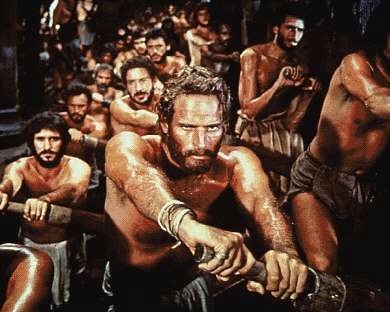
We got into a boat and pushed away from the shore.  It was a sailboat, but we didn’t know how to use sails, so we cut holes in the side of the ship for oars.  We cut the masts down and chopped them into oars.  We named the ship the SS WORK.  And then we began to row our way to the Land of Righteousness.  Row.  Row.  Row!
It was hard work.  We rowed until sweat dripped off our faces.  We rowed until our arms and shoulders ached.  We rowed until our hands were blistered.  We rowed through waves and wind and storms.  Row.  Row.  Row! 
After days and weeks, we could still see the dock where we had started.  “Work harder!” was the cry.  We rowed day and night.  We extended our shifts.  We rowed through fatigue and blisters.  Work.  Work.  Work!
After months and months on the SS WORK, we could still see our own land on the horizon, and we started to fight among ourselves. 
“Why are you resting?  We’ve got too much work to do.” 
“I rowed all last night.  You better take you’re turn tonight.” 
“Don’t tell me what to do.  I work just as hard as you.” 
“If you didn’t take so many breaks, we’d be there by now.” 
“If you were more focused, instead of piddling around with your own selfish games, we would be able to see the Kingdom by now.” 
“If you were more pure, maybe God would help us out here.” 
“Me, you’re the sinful one.  Listen to how you’re judging me.” 
Sometimes, we fought so much that someone got injured and couldn’t row anymore.  That just made us angrier. 
After years and years of struggling, when we could still see the mountain tops of our own land, we had made no more than a few miles of progress on a journey of a thousand miles.  We were out of food.  We were out of water.  We were out of supplies to maintain the ship.  The storms continued to come.  The ship slowly began to fall apart.   Water began leaking through the planks of the ship.  We stopped up the leaks with anything we could find.  We ripped up the sails and stuffed them into the cracks between the wood to stop the water from coming in.  Eventually, there were so many leaks, that we used our own clothing to patch the ship.  Nearly naked, exhausted and starving, we set ourselves to the oars again with renewed but exhausted diligence.   Row!  Row!  Row!!!  Work.  Work.  Work!
The ship was now taking on water.  It was slowly sinking.  All we could think to do was to keep rowing in the desperate hope that we would somehow make it if we just kept rowing.  We were now knee deep in water.  “Keep rowing!” someone shouted.  The ship was starting to break apart.  It was too old and too weary to withstand the waves anymore.  “Keep rowing!”  we all yelled.  “Together!   Row.  Row.  Row!  Work.  Work.  Work!!”
Then, over the shouting and rowing, one young lady heard something.  We’ll call her, the Hearer.  She heard a sound coming from outside the ship, and she had a deep sense in her chest that this was important.  She called to her friends, “Wait.  I hear something.” 
“Shut up!  You’re messing up our rhythm.  Row.  Row.  Row!” 
“I’m serious.  I hear something.  It sounds like a horn or people calling or something.  Stop shouting for just a minute.”
“No.  You’re just dreaming.  Keep rowing.  Row.  Row.  Row!”
“I’m going up on deck to look.”
“You’re doing what?  You can’t do that!  All hands at the oars.  Everyone has to row.  That’s our only chance.  Row.  Row.  Row!!”
“We’re sitting in water.  We’re going down.  Besides, I hear something.”  The Hearer went up to the deck of the ship.  It was beaten and battered by the waves.  Most of the ship’s tackle was washed away.  The rest was clogged and covered with seaweed and junk washed up by the waves.
Then, the Hearer looked up and saw the source of the sounds she was hearing.  There was a huge, beautiful ship.  She could see on the side of the ship the name: SS GRACE.  Once she was on the deck, the Hearer could clearly hear lots of sounds that were only dimly audible while she was rowing.  She could hear the ship’s horn calling out.  She could hear the Captain calling over the loudspeakers.  She could hear the crew of the ship calling to her over the railing.  She could hear the wind in the sails of the SS GRACE. 
The Captain called out over the loudspeakers, “Ahoy, there SS WORK.  You’re in trouble.  The King sent out a mayday call on your behalf.  We’ve come to rescue you and your crew.  We’ve come in the SS GRACE.  She’s a sailboat.  She’s powered by the Wind of the Spirit, so you won’t have to row anymore.  The SS GRACE can hold your whole crew, but you’ll have to leave your boat.  Come aboard.”
The crew of the SS GRACE was calling out with joy, “We’re so glad we found you.  Come on, get your friends.  The SS GRACE is a great ship.  We’ll take you to the King’s Land.  You’ll be well treated here.  Come on!  What are you waiting for?”
The Hearer called out to the SS GRACE, “Why?!  Why are you here?  Why do you want to rescue us?”
The Captain left his loudspeaker and rushed to the railing of the SS GRACE.  “The King loves you.  He wants you back in his own Land.  He doesn’t want you to live like this.  Come on.  Return to the King.”
The Hearer turned and rushed back into the inside of the boat where her friends were rowing away with all their strength.  “Row.  Row.  Row!  Work.  Work.  Work!”
“Oh, you’re back,” someone close to her sneered.  “Get to work.  Row.  Row.  Row!”
“No,” she responded timidly.
“What?!  Shut up, and get to work!  Work.  Work.  Work!”
“No,” with just a little more courage.  “We don’t have to row anymore.”
“What?  Of course we have to row.  We have to row until we die.  If we work hard enough, we can make to the Kingdom of Heaven and be called a Righteous one.  If we stop rowing, we die.  Row.  Row.  Row!”
“No, I’m telling you.  There’s another way.  We don’t have to row anymore.  Another ship has come to save us.”
“She’s hallucinating (seeing things that aren’t there).  There’s no one for miles around.  Rowing is the only way.  Row.  Row.  Row!”
“Just stop rowing for a minute and come up on deck to see for yourself.  There’s a ship here to save us.  It’s called the S. S. GRACE.”
“Grace - what does that mean?  Row.  Work.  Row!”
“I’m not sure, but I think it means we don’t have to row anymore.  Come and see for yourself.”
Then, one brave and curious person stood and said, “I’ve heard of the SS GRACE, but I’ve always thought it was a fairy tale, too good to be true.  I’ll go look.”
“Somebody shut her up before she gets somebody else to stop rowing.” 
But the Hearer and the Seeker escaped to the deck of the ship before anyone could stop them.  Then, the Seeker saw that the SS GRACE is the truth.  The Seeker saw the Captain and recognized some kindness in his face that he had always longed for.  The Seeker saw the full sails of the SS GRACE and noticed that there were no oars on that ship.  No one ever rowed the SS GRACE.  It was powered by the Wind of the Spirit.  The Seeker saw the crew of the S. S. GRACE.  Some of them were throwing rescue lines over to the SS WORK.  Some of them were climbing over the sides of the ship trying to reach the SS WORK, so they could help people cross over.  They moved with joy and purpose. 
This was all enough to convince the Seeker.  The Hearer and the Seeker returned inside their own ship.  “It’s true!” they both said together.
“Shut up.  Row.  Work.  Row!”
“No, really.  I saw it, too,” the Seeker cried with joy.  “The King has sent the SS GRACE to save us.  He knew we couldn’t make it.”
“Why would the King do that?  What does he care about us?  We’re just stinking people from the Land of Stink.  Row.  Row.  Row!  You want to make to the land of Righteousness boys?  Well, this is the only way.  Work.  Work.  Work!”
“The Captain said that the King made us, and He wants us back.  The Captain came on a new ship.  It’s a sailboat.  It doesn’t even have oars.”
“No oars?!!  How does it move?  Row.  Row.  Row!”
“It’s powered by the Wind of the Spirit.”
“What’s that?  Never mind.  I can’t imagine life without rowing.  What would we do if we couldn’t row?  Row.  Row.  Row!”
“Yeah, we’ve worked hard on this ship.  We’ve put our blood, sweat, and tears into the SS WORK.  It’s part of us.  Let’s just work harder.  Work.  Work.  Work!”
“Look around you people.  This ship is going down.  It’s sinking.  You can never make it by working harder.  The SS GRACE is the only way.”
A big guy in the front said, “I’m not sure I want the SS GRACE to save me.  I didn’t ask for a rescue boat.  I don’t want to be pulled from the water like some drowning rat.  I’d rather make it on my own.  Thanks, but no thanks.  Row.  Row.  Row!”
Someone in the back in the shadows said, “Maybe the SS GRACE came for you, but I don’t believe the King would send anyone after me.  I’m a dirty, stinking sinner from the Land of Sin and Death.  I’m just a piece of trash trying to paddle my way to heaven.  Once the King – or anyone else for that matter – sees who I really am, they’ll toss me back into the trash heap where I belong.  Go ahead.  I don’t have anything worth saving.  I’m staying here.  Row.  Row.  Row!!”
“The Captain said he’ll take everyone who is willing to put their trust in him and the SS GRACE.  He said he won’t turn anyone away.  We just have to put our life in his hands.  Look we’re going.  Are any of you coming with us?  There isn’t much time.”
About half the crew of the SS WORK got up and waded through the water to go up on deck to meet the SS GRACE.  The other half sat at their oars, rowing away. 
Some were bitter, “No sir, you’re not going to find me accepting any handouts.  I’ll earn my own way.”
Some were crying, “I just can’t believe it’s true.  I can’t believe they’d take me.  I just can’t believe it – not for me.”
Some were just staring into space, rowing away, almost as if they had never heard or seen anything about the SS GRACE.
When the Seekers from the SS WORK reached the deck of their ship, they were greeted by friendly workers of the SS GRACE who gave them blankets and led them to the bridge between the two ships.  The rest of the crew of the SS GRACE stood on deck cheering wildly as each person was rescued. 
As each person stepped onto the SS GRACE, the Captain smiled and reached out his hand for them.  It was then that they saw the nail holes in his hands.  Then, they understood that he had laid down his own life to make this rescue possible.  Each person, one by one, took his hand and let the Captain pull them aboard the SS GRACE.  Then, the Captain hugged and kissed them and sent them inside the ship to rest, to eat, to heal. 

We need to talk for a minute or two about life on the SS GRACE.  The SS WORK is powered by oars, by human effort.  However, the SS GRACE is powered by the Wind of the Spirit.  It is a sailboat, and when the Wind of the Spirit fills its sails it moves faster and better than any ship can move by human effort.  There is still work to do on the SS GRACE.  But it is a lighter work with a lighter responsibility.  On the SS GRACE everyone understands that our job is not to make the ship move.  Our job is just to get the sails up so that the Wind of the Spirit can take us where He wants to take us. 
I have a confession to make.  I am a recovering Workaholic.  I was a faithful member of the SS WORK.   Now, I have crossed over into the SS GRACE.  I have been working as a crewmember of the SS GRACE for a long time.  I have even helped some new people onto the SS GRACE.   But often I still think like a crewmember of the SS WORK.  Work.  Work.  Work!  Row.  Row.  Row! 
Even worse, I often still feel like a crew member of the SS WORK: dirty, fatigued, driven, bitter, worthless.   Sometimes, deep down inside, I still can’t believe that God would rescue me.  Sometimes, I can’t stand that I can’t move forward simply because of my own free will and effort.  Sometimes, I want to poke holes in the SS GRACE and get out an oar.  Sometimes, I want to hit people with an oar and tell them to get to work.  Work.  Work.  Work!
In times like these, (in times like this vacation), the Captain pulls me aside and reminds me of the King’s free love for me.  He holds my hand, and we sit on the deck feeling the Wind in our faces.   Then, He gently teaches me again the ways of GRACE.  And when I am patient enough to listen, I relax and grow.

I don’t know where you are in this story.  You may be a recovering Workaholic like me, or you may still be on the SS WORK.  You might be still on the Mainland of Sin and Death.  You might not have even heard much about the Kingdom of God and the Land of Righteousness. 
Wherever you are, the King loves you, and He has sent the SS GRACE to rescue you.  The Captain joyfully invites you to put your trust in his GRACE.   When you do, the Wind of the Spirit will bring you home. 
May God help us all to put our trust in GRACE, and may he teach us anew the ways of GRACE.